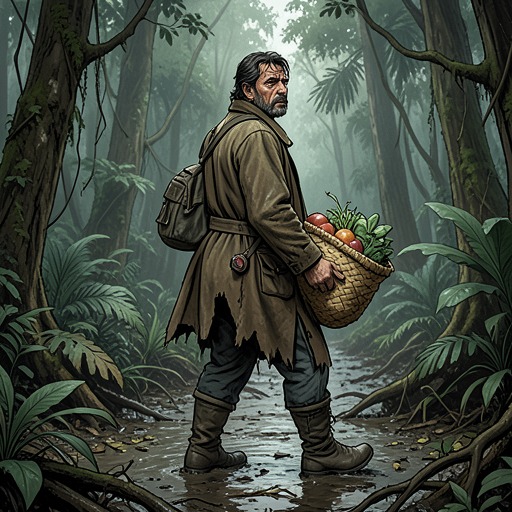
Gallipoli von Kessler
The Narrow Road to the Deep NorthGallipoli von Kessler, known simply as Kes, is an Australian soldier whose life connects the inherited anxieties of a German migrant family to the shared hardships of war and the unsettled return of former prisoners. An apple grower from the Huon Valley, he is associated with a dry, irreverent manner: during the campaign he jokes about hardship, and later, in the prison camp, he acts decisively when Darky Gardiner is about to be executed. After the war, his frayed trousers and blunt observations mark him as one of the comrades gathered again in Hobart, where memory brings the dead into the room but cannot restore what captivity has changed.
Identity and family background
Kes’s full name carries the history of his family’s attempt to belong in a new country. His father, Karl von Kessler, was German and had adopted the aristocratic-sounding von, adding it to the peasant name Kessler as part of a performance of former-world status. The family’s security in Australia proved fragile: during the anti-German hysteria of the Great War, their barn was burned, and Karl feared losing everything in the country where the family had settled.
That hostility reached beyond the family. The mountain settlement behind Hobart where German migrants lived changed its name from Bismarck to Collinsvale. Karl, in turn, named his son for Australia’s involvement in the disastrous invasion of Turkey the year before the boy was born. The result was Gallipoli von Kessler, a name larger than the man the narrator describes: his face is compared to an old apple core. The contrast between an imperial-sounding name and an ordinary, weathered appearance gives Kes’s introduction its wry emphasis; the name records public history, while his family’s story reveals its private cost.
Kes is also identified as a Huon Valley apple orchardist. In the wartime scene where he is introduced, a red-haired, lanky machine gunner makes a sardonic comparison to Beau Geste, and the narration then supplies Kes’s full name and settles on the familiar Kes. The comic register belongs to a world in which soldiers make jokes amid destruction, but the surrounding campaign steadily strips away the distance that humor can create. The contrast is not presented as a heroic transformation so much as a measure of what the men are forced to endure.
Campaign and captivity
The Australians reach a village still occupied by French forces while the Royal Navy bombards it. From a distance, soldiers watch the methodical destruction; after the French withdraw, the Australians advance through the damaged settlement. The scene places Kes’s introduction amid military devastation rather than at the beginning of a private biography. In the town, the wreckage of vehicles and military equipment sits alongside open shops, people cleaning up, and off-duty Australians searching for souvenirs. The coexistence of ordinary trade and destruction offers a glimpse of the strange routine that continues around the soldiers.
Kes’s wartime perspective is also captured in Java, after the Australians’ surrender. As the men pass women picking tea, he remarks on their changing from wet to dry sarongs and tending to one another’s hair as an especially harsh kind of punishment. The observation is joking and male-centered, but its place in the larger account matters: at that point, the men can still imagine deprivation through the lens of what they are denied. The story later makes clear how quickly such preoccupations give way to the more immediate requirements of survival.
After six months, a thousand prisoners are transported toward a new project in Siam. They spend three days crowded into the hull of a worn-out boat before being marched to Changi Gaol. There the prisoners from Dorrigo Evans’s group appear emaciated and poorly equipped beside the well-dressed Australian soldiers already at the camp. The commander, Brigadier Crowbar Callaghan, calls them Java Scum and refuses Dorrigo’s requests for clothing, boots, and provisions. Kes’s account belongs to this larger passage from campaign into captivity: the change in circumstances is not a return to safety but the beginning of another stage of hardship.
On the railway, the prisoners are made to clear jungle, break rock, move earth, and carry sleepers and rails with simple tools and their own labor. Hunger, illness, and exhaustion become the terms of daily life. The hospital hut fills with the sick and dying; the surviving men increasingly think about food and rest rather than the concerns that occupied them before captivity. The narrative specifically marks the change in Kes’s outlook: the earlier idea that being unable to touch a woman was a punishment has disappeared, along with thought of women itself. The railway has narrowed the prisoners’ world to immediate bodily need and the struggle to remain alive.
Kes and Darky Gardiner
Kes’s clearest individual act comes when Darky Gardiner is placed before Colonel Kota and the Goanna. Kota’s confidence in order has faltered, but Darky is still waiting for the sword to fall. Kes tells him that the danger has passed, then checks that Kota and the Goanna have actually gone before telling Darky he can open his eyes. When Darky does so, the executioners have disappeared and Kes is the only person beside him. The sequence makes the rescue concrete: Kes does not merely offer reassurance; he verifies the threat has ended before inviting his comrade to look.
The exchange also reveals how much of the moment depends on simple, reliable information. Darky cannot see what has happened, and Kes’s short announcements guide him from anticipation of death to the knowledge that he is still alive. The episode places Kes in direct opposition to the violence of the execution scene without turning him into a speech-making hero. His intervention is practical and immediate, and its consequence is decisive for Darky: he survives the moment and finds Kes waiting nearby.
Return, memory, and reunion
After demobilization, Kes appears among former comrades gathered around the fire at the Hope and Anchor in Hobart. The reunion takes place in 1947 or 1948, on a cold night when the men stand close enough to the fire to heat the backs of their trousers before shifting away for another beer. Kes arrives in old worsted trousers so frayed at the cuffs that they seem to have come from a scarecrow. The detail makes his return visible without suggesting that civilian clothes or a pub can undo the intervening years.
The men recall those who did not return. Kes mentions Darky, while others remember Lizard Brancussi, Wat Cooney, Yabby Burrows, Jack Rainbow, and Tiny Middleton. Sheephead Morton even speaks of Rooster MacNeice, whom he had once expected to die. As Jimmy Bigelow sings an optimistic refrain, the group briefly experiences the dead as present in their shared laughter. Yet the scene holds that warmth against the unsettled reality of survival: Jimmy says little, and his marriage is no longer the one he left behind—or perhaps he has returned changed. Kes’s mention of Darky belongs to this collective act of remembering, not to a claim that the gathering can make the loss right.
Later that night, after the men have been thrown out of the pub, Kes strides ahead on the way to Nikitaris’s fish shop, his worn trousers guiding the others through the empty Hobart street. The shop is closed, with only the lights illuminating the fish tank at the front. The comrades had imagined something different, but find no gathering inside and no one waiting for them. Kes calls the group’s indecision foolish, observing that even chickens would do something. Jimmy, who has already described himself as feeling empty, picks up a rock and breaks the shop window. The article’s last glimpse of Kes is therefore not a tidy resolution but a night of aimless company and disrupted expectation: his practical, mocking voice accompanies the group, while the veterans’ unease finds an outlet in Jimmy’s sudden act.